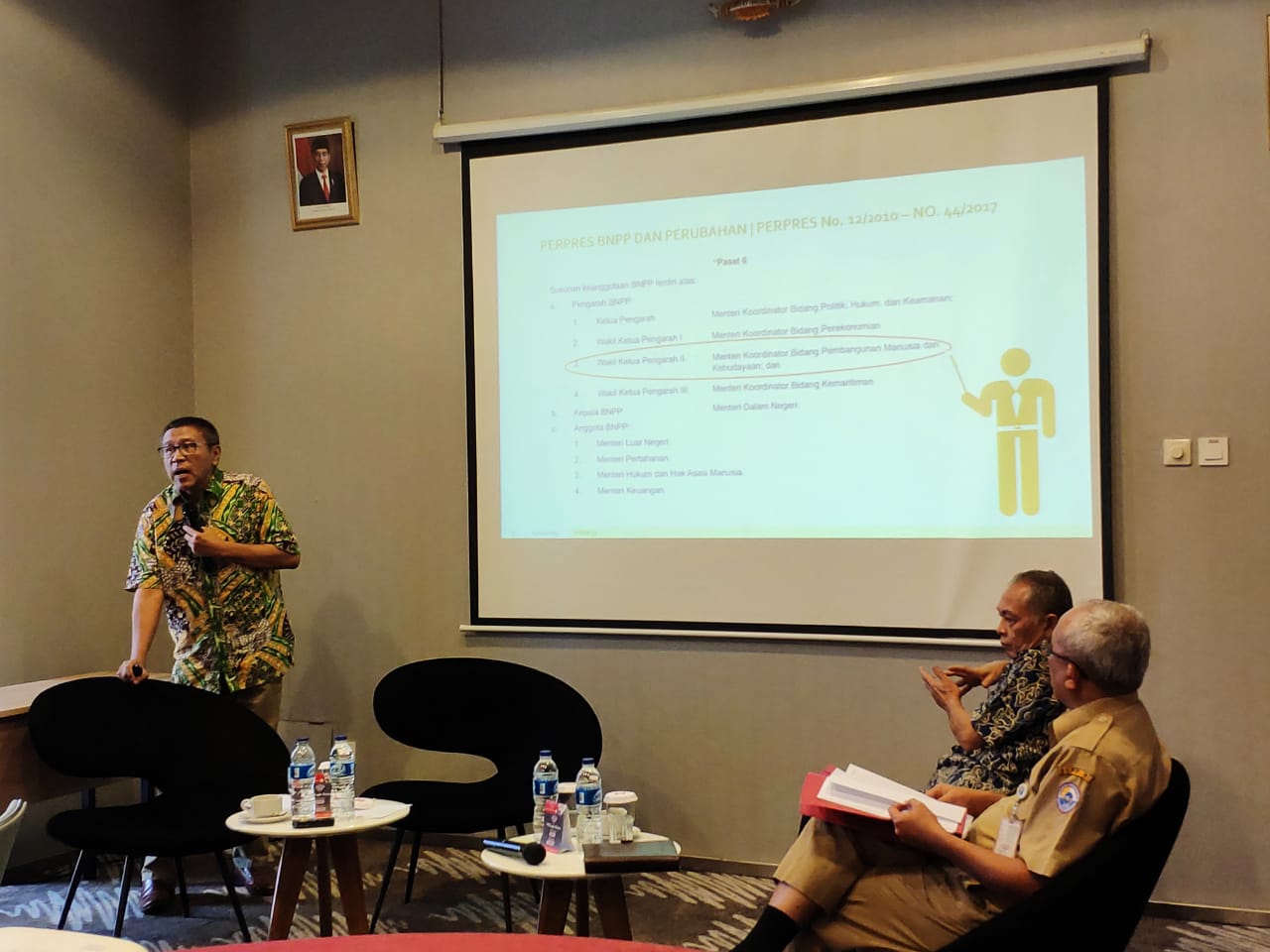
Article 33 In mid-2019, Indonesia began conducting a joint study with the Coordinating Ministry for Human Development and Culture (Kemenko PMK) regarding strengthening the role of sub-districts in border areas. On December 10, 2019, an initial dissemination of the study was conducted with the theme of "Border Area Development: A Security or Welfare Perspective?". The dissemination was attended by: (1) Risfan Munir as the study researcher; (2) Wijanarko Setyawan who is the Assistant Deputy for Strategic and Special Area Empowerment, Kemenko PMK; (3) F. Gatot Yanrianto Assistant Deputy for Border Potential of Marine Areas, BNPP.
This study is motivated by the weak role of sub-districts in development in border areas, even though sub-districts should be able to play a major role in coordinating development from the lower and upper levels (village and district). In addition, a stronger role of sub-districts is also needed so that the stigma of border areas that were originally the country's backyard can change to the country's frontier region. The study was conducted in two regions, namely Serdang Bedagai Regency (Sergai) and North Central Timor (TTU). The number of Lokpri in TTU is much greater, covering 7 sub-districts compared to Sergai which only has 1 sub-district, namely Tanjung Beringin. However, the Lokpri in Sergai is strategic due to the presence of Berhala Island, with a distance of 22 miles, expanding the sea area from the original 12 miles. Lokpri in TTU has a land border with Timor Leste in the Oecussi enclave area.
Over the past five years, border region development policies have been inward-looking, but this has gradually shifted to an outward-looking approach. This means that border areas serve as the gateway or front porch in our relations with neighboring countries. Article 33 Indonesia researcher Risfan Munir explains that the government's focus on the Lokpri sub-districts is advantageous because this approach allows for funding to come from both the top, namely ministries/agencies (K/L) at the national level and regional government organizations (OPD) at the provincial and district levels, and from the bottom, namely villages, through the existence of village-owned enterprises (BUMDes) and village funds. This convenience is intended to reduce the level of isolation of the Lokpri area.
Wijanarko Setyawan, Assistant Deputy for Strategic and Special Area Empowerment at the Coordinating Ministry for Human Development and Culture, explained the coordination framework for development and welfare in border areas. In this case, the Coordinating Ministry for Human Development and Culture focuses on accelerating basic services. In general, isolated conditions and limited access at the border cause poverty and low basic services. Each district is tasked with implementing basic services, by making border areas part of regional development. As an illustration, in total throughout Indonesia there are 187 local sub-districts spread across 13 provinces and 41 districts/cities covering 1,674 villages/sub-districts, spread almost evenly across western Indonesia (65), central Indonesia (60), and eastern Indonesia (62). Regarding the condition of border areas, the Human Development Index in 2015-2018 showed an increase in growth in both underdeveloped areas (3,461 TP3T) and border areas (2,891 TP3T) exceeding the growth of the national HDI (2,651 TP3T). In contrast to what has been stated, Wijanarko highlighted the contradictions inherent in border development. In Sintang Regency, the border area is largely a conservation area, making development difficult. It also includes indigenous communities who lack legal protection.
F. Gatot Yanrianto, Assistant Deputy for Marine Border Potential at the National Disaster Management Agency (BNPP), highlighted other aspects of border issues, including security and the environment. For the record, Indonesia's land borders span 3,152 km, with a coastline of 99,900 km, second only to Canada in the world. Indonesia shares land borders with three countries: Malaysia, Papua New Guinea, and Timor Leste, and maritime borders with 10 other countries.
There are four main aspects to border management. First, national border management, including the settlement of land, sea, and air boundaries and their utilization. So far, two boundaries remain unresolved in East Nusa Tenggara (NTT), while many areas of sea and air boundaries remain unresolved. Second, cross-border management, including the prevention of border crimes, illegal trafficking, and terrorism. Third, border area development, where electrification is a significant issue. Nearly all border issues, especially islands, require generators, coupled with fuel supply issues. Furthermore, border areas require adequate internet access, just as school exams are now computer-based. Fourth, institutional management, requiring the establishment of a Regional Development Planning Agency (BPPD), which requires a Regional Regulation (Perda), requires intensive consultation with the Ministry of Home Affairs during the formation process.